As high-power fiber laser systems push toward multi-kilowatt scaling, Coherent beam combining (CBC) has emerged as one of the most viable techniques to overcome the physical limits of single emitters. However, even for CBC the maximum output power remains limited by a number of thermal and non-linear effects such as stimulated Brillouin scattering (SBS). Furthermore, the move toward new wavelengths (specifically 2 µm for Thulium/Holmium systems) and higher number of combined channels introduces critical challenges. While much attention is paid to active phase locking (kHz–MHz bandwidth), a frequently overlooked aspect is the "coarse" optical path delay. This article analyzes the physics of SBS suppression, its impact on coherence length, and thus emerging necessity for employment of high-precision, low-loss optical delay lines to bridge the gap between fiber splicing accuracy and fast phase modulation.
1. Introduction: The Imperative for Power Scaling
Fiber lasers have revolutionized the solid-state laser market largely due to their superior heat dissipation (high surface-to-volume ratio) and compact footprint. By 2010, fiber technology had already established itself as the leader in high-average-power generation while maintaining diffraction-limited beam quality.
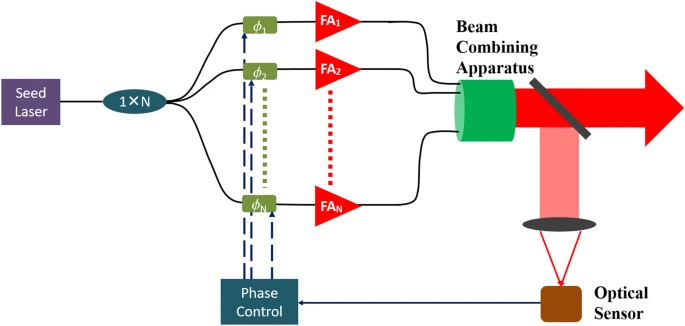
However, single-emitter fiber systems are approaching fundamental physical limits. To push their output power beyond a few kW threshold, researchers are actively searching for advanced scaling techniques such as coherent beam combining (CBC). Here light from seed laser is typically split into multiple channels, independently amplified and coherently interfered at the output to achieve high power levels - see scheme in Figure 1.
Recently, the industry started shifting toward the 2 µm spectral window (Thulium/Holmium). This wavelength offers higher thresholds for nonlinear effects, safer atmospheric propagation for directed energy, and new possibilities in polymer processing. However, this shift renders many standard "telecom-grade" components obsolete, necessitating a new class of optical hardware.
2. The Power Scaling Limit: SBS and Nonlinear Effects
There are a range of effects that limit the maximum achievable power in fiber lasers. While thermal effects (such as transverse mode instability, TMI) are a growing concern, the immediate "hard limit" for narrowband power scaling in optical fibers is stimulated Brillouin scattering (SBS).
SBS is an inelastic scattering process where photons interact with acoustic phonons in the fiber core. This creates a backward-propagating Stokes wave, which gets further reinforced due to an emergence of a positive feedback loop. As a consequence, once the SBS threshold is reached, the back-reflected power can quickly lead to instabilities of even fatal damage of the seed laser. For standard narrow-linewidth single-mode fiber lasers the SBS threshold can be as low as <100 W.
It should be noted that other nonlinear effects, such as stimulated Raman scattering (SRS), self phase modulation (SPM) and self focusing, also play a role in limiting the power that can be sent through optical fibers, but SBS is typically the primary bottleneck for continuous-wave (CW) and long-pulse regimes.
3. The Trade-Off: SBS Suppression vs. Coherence Length
To overcome the SBS limit, the standard mitigation strategy is spectral broadening. Since the SBS gain bandwidth is extremely narrow (~30–100 MHz), broadening the seed laser linewidth to the GHz range (e.g., with white noise phase-modulation) significantly increases the SBS threshold.
However, since the coherence length is inversely proportional to the linewidth, this solution introduces a critical trade-off: the spectral broadening must be done so that SBS is efficiently suppressed (and thus maximum power is achieved) while still keeping sufficient coherence to maintain high beam combining efficiency at the output of the system. In practice, the seed laser linewidth is broadened to a few GHz which reduces the coherence length of the corresponding laser down to a few milimeters. Obviously constructive interference is only possible if the optical path length difference between all channels is smaller than this.
4. Bridging the Gap: The "Three-Stage" Control Hierarchy
Maintaining sub-centimeter path matching across multiple fiber arrays (where fibers can be meters long) presents a mechanical engineering challenge. Standard fiber splicing and cleaving techniques typically achieve an accuracy of 5–10 cm at best, which is insufficient.
On the other end of the chain, fast phase actuators (piezo fiber stretchers or electro-optic modulators) are employed to correct atmospheric turbulence and mechanical vibrations. However, these devices have a very limited range (typically a few wavelengths, 5–20 µm).
This creates a path length matching gap: fiber splicing is too coarse, and phase modulators are too short-range. A viable solution to bridge this gap is using an optical delay line with millimeter to centimeter travel range to bring the individual channels within the locking range of the fast actuators. This effectively forms a three-stage control hierarchy - see the overview in Table 1.
| Stage | Mechanism | Range | Resolution | Function |
|---|---|---|---|---|
| (1) Coarse | Fiber cutting/splicing | meters | 5-10 cm | Basic layout |
| (2) Intermediate | Fiber optic delay line | 10-20 cm | < 1 µm | Matches path lengths to withincoherence length |
| (3) Fine | Fast phase modulator | ~1-10 µm | ~ 1 nm | Locks phase noise |
Table 1: Overview of the range and resolution of three principal stages used for path length (phase) matching in CBC.
5. The FODL-MDX Architecture: Designed for 2 µm CBC
While the need for delay lines is established, standard commercial units (often repurposed from 1550 nm telecom networks) fail to meet the rigorous demands of high-power 2 µm systems.
To fill this gap, OptiXs developed the FODL-MDX, a modular system for fiber optic delay lines specifically engineered to solve two critical failure points in standard components:
A. Verified Low Insertion Loss at 2 µm
Standard commercial delay lines often exhibit Insertion Loss (IL) > 3-4 dB when operated at 2000–2050 nm. This is not always evident from the listed specifications, which may be generated by extracting the IL value found for 1550 nm. Yet, in a kilowatt-class amplifier chain, each dB of loss in the seed path forces pre-amplifiers to work harder, increasing the thermal noise floor and degrading beam quality (M²).
The FODL-MDX guarantees IL < 2.5 dB specifically measured at 2000 nm and valid for both SM and PM fibers. In combination with a great IL uniformity (0.2 dB) and exceptional resolution (< 0.33 fs) across the whole delay range this makes the FODL-MDX a great platform for setups operating in the 2µm spectral window.
B. Multi-Channel Scalability
As CBC systems scale from 2 to 8, 16, or more channels, managing individual delay stages in the setup becomes impractical.
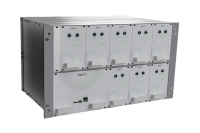
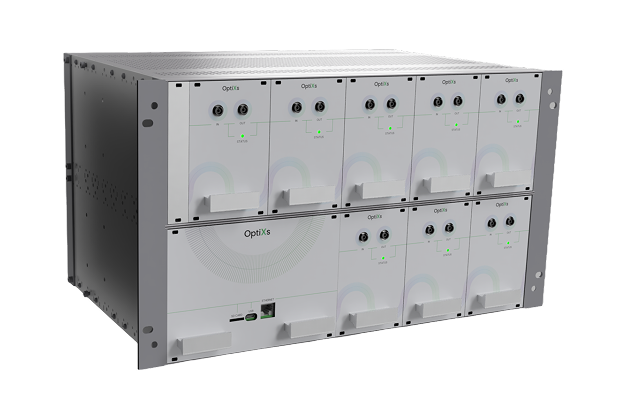
The FODL-MDX platform is a rack-mounted modular system where a single controller drives up to 8 delay units via Ethernet/USB. However, the design is such that any number of channels can be configured, ensuring easily accessible scalability so much needed especially in development and testing of CBC systems.
6. Conclusion
As the industry requirements push fiber laser systems to scale beyond the limit accessible by single fibers, coherent beam combining inevitably becomes a field to explore. However, the physics of power scaling in fibers dictates that as power rises, undesired non-linear effects such as stimulated Brillouin scattering must be accounted for. A commonly used technique for suppressing SBS is broadening the linewidth, which leads to dramatic decrease of the tolerance for path length mismatch between individual channels in the CBC system.
Precision optical delay lines are no longer just "lab accessories"; they are critical active components required to bridge the gap between mechanical assembly tolerances and the coherence requirements of high-power spectral combining.
By securing low insertion loss at 2 µm, providing sub-femtosecond resolution in a scalable all-in-one-box architecture, the OptiXs FODL-MDX enables researchers to push the boundaries of directed energy and material processing without being limited by the passive components in their front-end.
For more information on the FODL-MDX specifications and integration, visit www.optixs.cz/en/fodl-mdx-p.