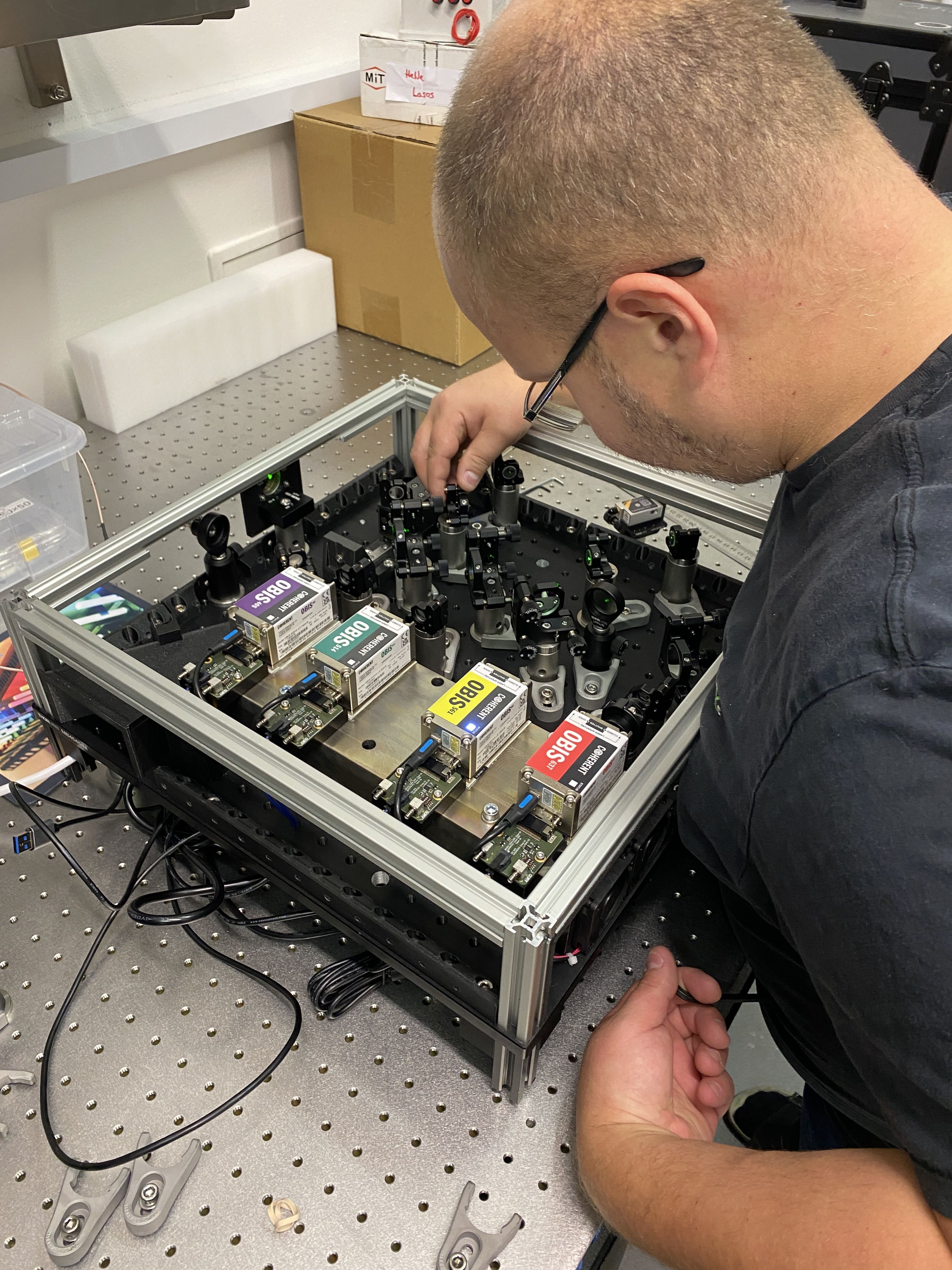
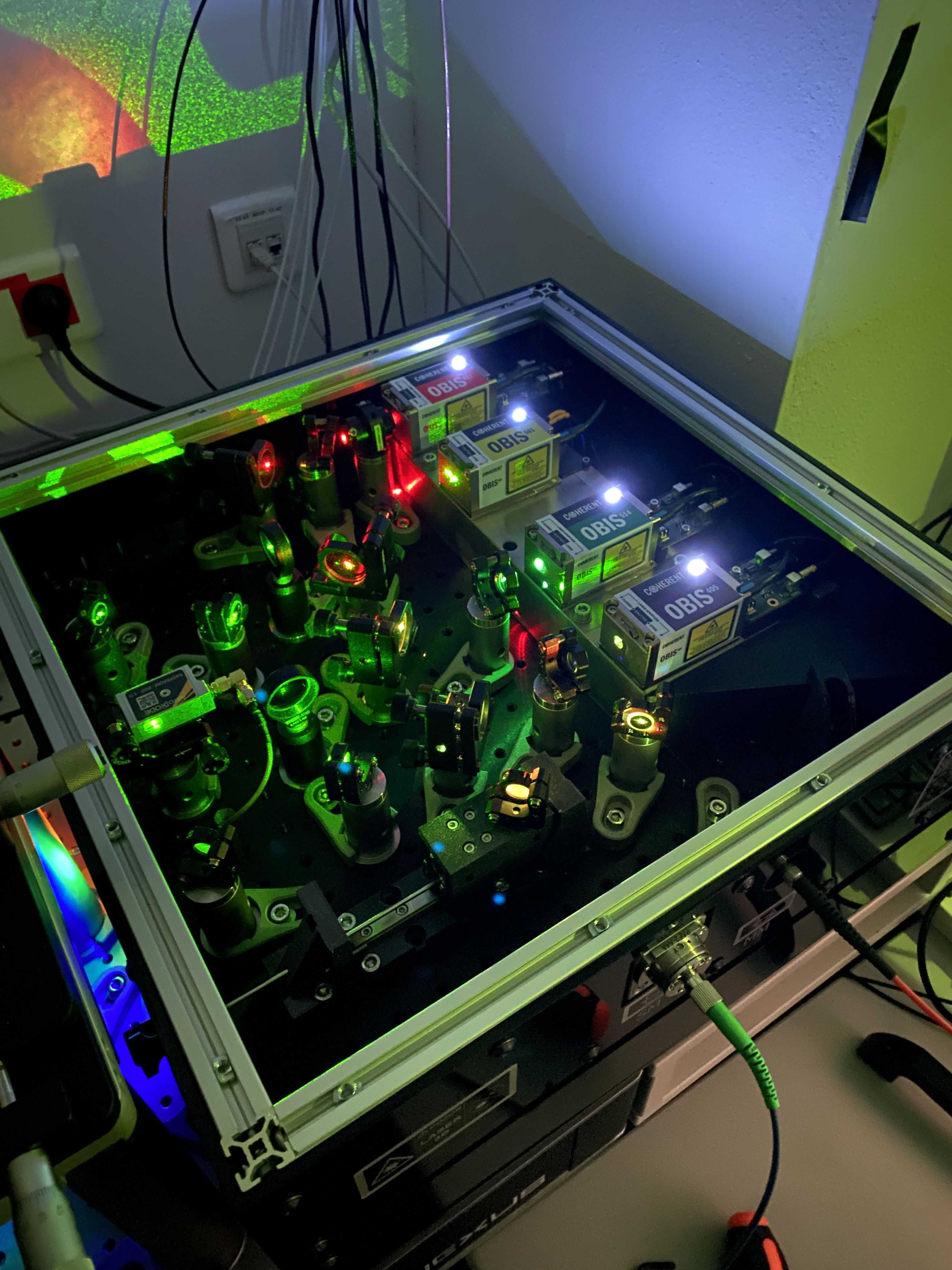
The above specifications lead quite directly to a solution using a beam combiner. When designing the assembly, the customer even inquired about existing commercial solutions from several laser manufacturers, but none of them were able to meet all the requirements and fit within the customer's budget. This led to a custom solution from OptiXs. The heart of the beam combiner is Coherent's OBIS lasers, specifically wavelengths of 405, 514, 561, and 637 nm. However, several technical challenges had to be overcome during their integration. For example, fast modulation at a wavelength of 561 nm is not available due to the lack of a suitable active medium emitting directly in this range (the so-called "green gap"). Our beam combiner solved this by inserting a fast acousto-optic modulator into the path of this laser. Externally (from the user's point of view), the laser control ultimately works the same as for other "direct diode" lasers in the assembly - just apply a TTL signal to the appropriate SMA connector on the rear panel of the device.
The relatively high power of the lasers also presented a potential complication - e.g., 140 mW for the blue (405 nm) laser. Connecting such high power to a single-mode (SM or PM) fiber can very easily lead to burning the fiber end. We therefore had to provide suitably designed protection (so-called end caps). We also had to pay attention to the active cooling of the lasers so that the beam would not be destabilized by heating.
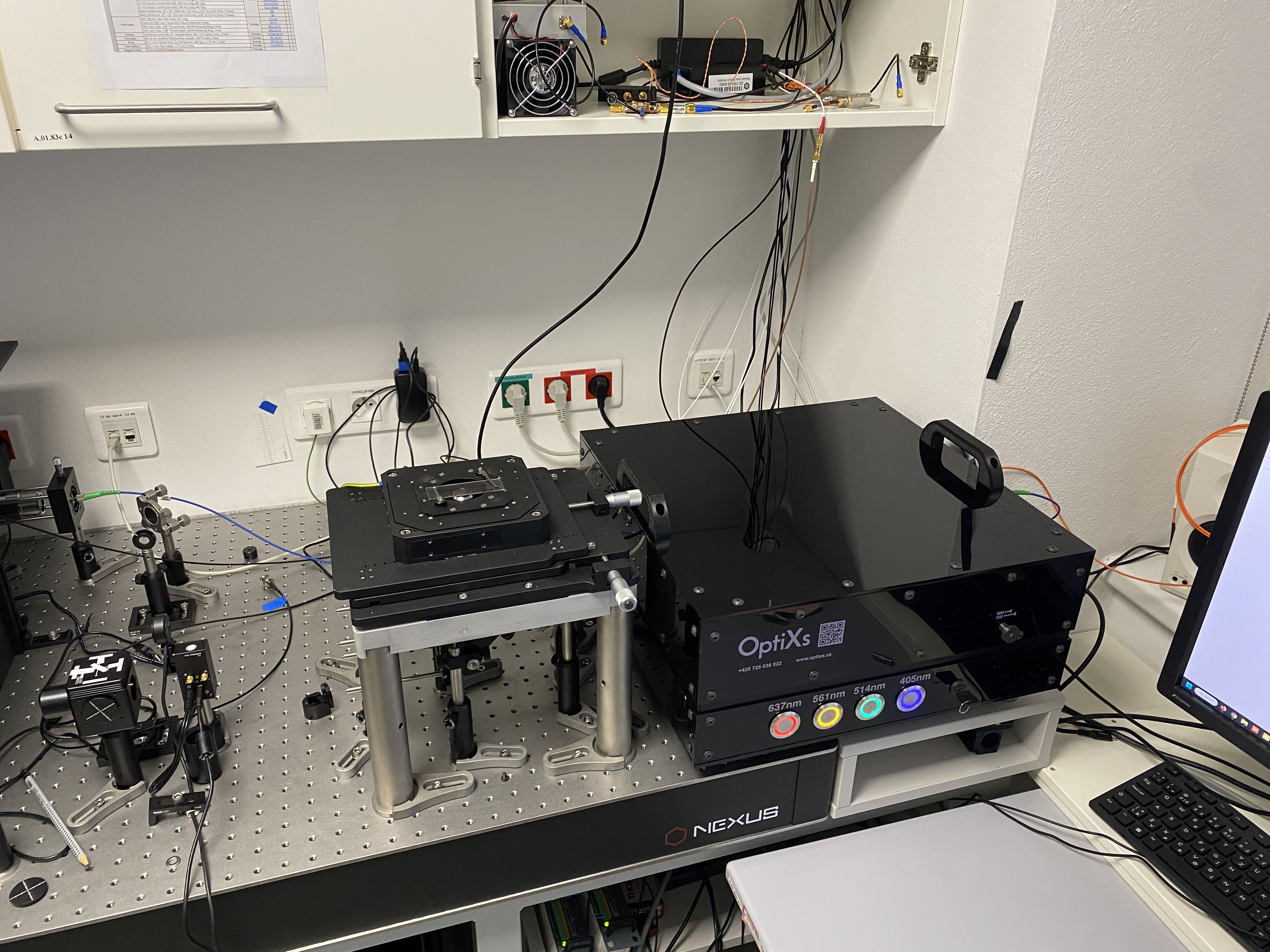
The beam combiner is equipped with a central switch (key), interlock, and buttons for turning the lasers on and off individually. A manual lever can be used to switch between PM and MM fiber outputs. In addition to SMA connectors for external laser control (modulation), a USB port is also available for remote laser management via Coherent Connection software. Although the beam combiner is ultimately placed directly on the optical table, its design also allows for vertical mounting (e.g., wall mounting).
The beam combiner immediately began serving the scientists at ÚOCHB according to their expectations, as evidenced by this report from Czech Television: Science 24 – Nanomaterials are changing the world.
Device parameters
-
4x Coherent OBIS laser
- LX 405 nm, 140 mW
- LX 514 nm, 40 mW
- LS 561 nm, 150 mW
- LX 637 nm, 140 mW
- Common output selectable between PM and MM fiber (each 2 m long)
- Nominal efficiency of coupling into PM fiber for all lasers > 50% (power at fiber output / power directly from
laser)
- Digital modulation of all lasers using external TTL signal
- Central switch (key)
- Interlock