- Implementation: Coherent / Bystronic-Rofin application laboratories
- Application: Marking cable insulation (PVC, PUR, silicone) in Mark-On-The-Fly (MOTF) mode.
- Target parameters: Feed speed 2 m/s (120 m/min).
- Coding: 1D barcode (approx. 50 x 6 mm), with a future outlook toward 2D QR codes.
- Success criteria: High machine readability, long-term durability, and absolute process repeatability.
Contents
1. Analysis of Alternative Wavelengths (1064 nm and 532 nm)
Before switching to UV technology, systems with different wavelengths were tested to verify the physical response of the materials to beam absorption at high speeds.
Fiber Lasers (1064 nm)
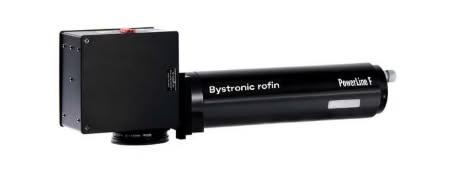
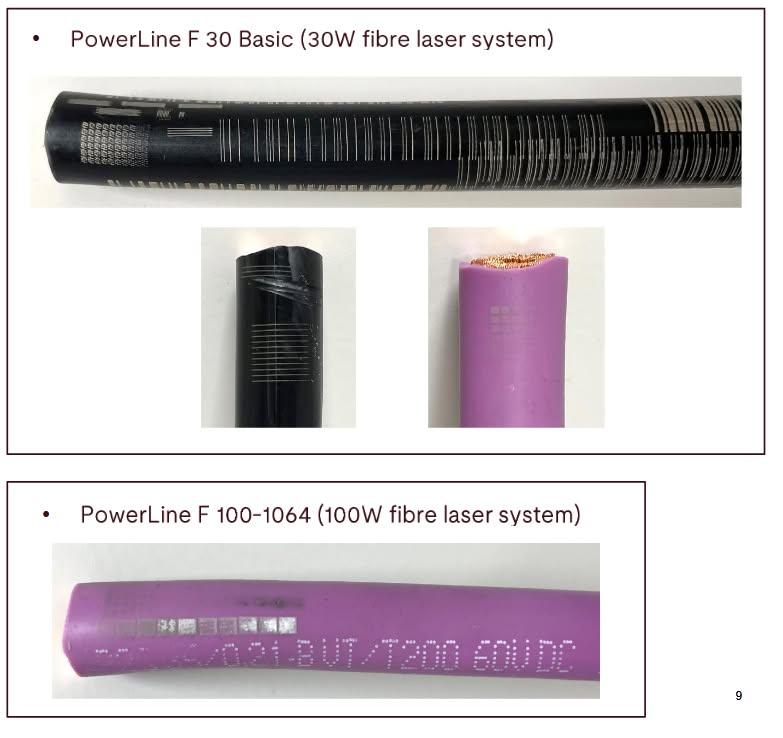
30 W and 100 W fiber lasers (PowerLine F 30 Basic, PowerLine F 100-1064) demonstrably can mark all three tested types of wire insulation. The required material response occurs, but the limiting factor is the process dynamics at high speeds.
- At the target speed of 2 m/s, contrast is created on both types of black cables that is visible to the eye. However, at this speed, the individual bars of the 1D code consist of strongly separated laser lines, which physically prevents readability by machine scanners.
-
For the purple silicone cable, visible contrast and color change can only be achieved
with a significant reduction in process speed. Increasing the power to 100 W brought sharper
details, but it was still not enough to achieve full contrast at 2 m/s.
Green Laser (532 nm)
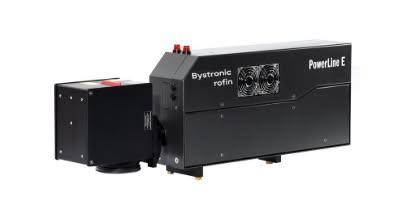
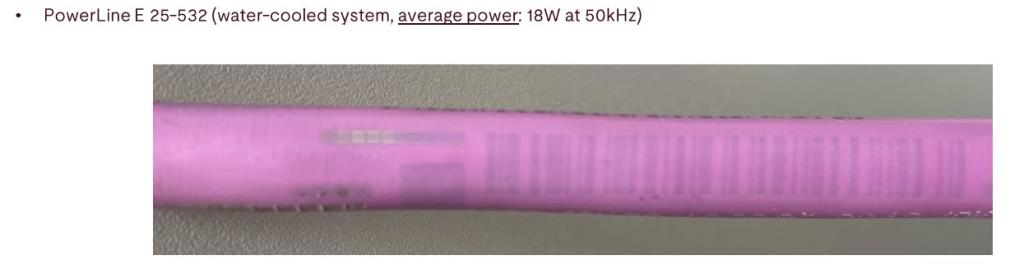
The tested water-cooled PowerLine E 25-532 system (18 W) showed a slight improvement in absorption.
- The foaming material response is more consistent than with fiber lasers.
- Barcode marking is feasible and readable with this technology at a speed of 1 m/s.
- However, when attempting to reach the limit speed of 2 m/s, the level of contrast fades and becomes insufficient.
2. Implementation of UV Technology 355 nm – PowerLine E 10 QT System (10 W)
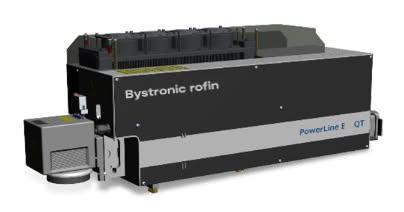
Based on previous tests, the customer identified that the 355 nm wavelength achieved the best results, while their own 3 W system was hitting a production ceiling at 1 m/s. The first phase of testing at the manufacturer therefore included deployment of the 10 W air-cooled PowerLine E 10 QT subsystem.
The measured data showed that for purple silicone, 10 W of power is sufficient to reach the target of 2 m/s, but for black compounds, a reduction in speed is necessary to maintain readability.
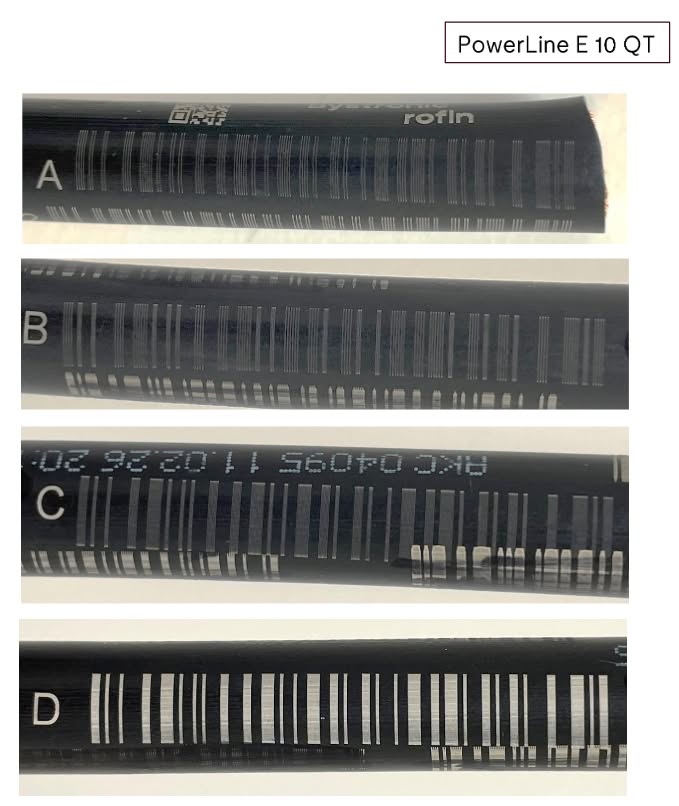
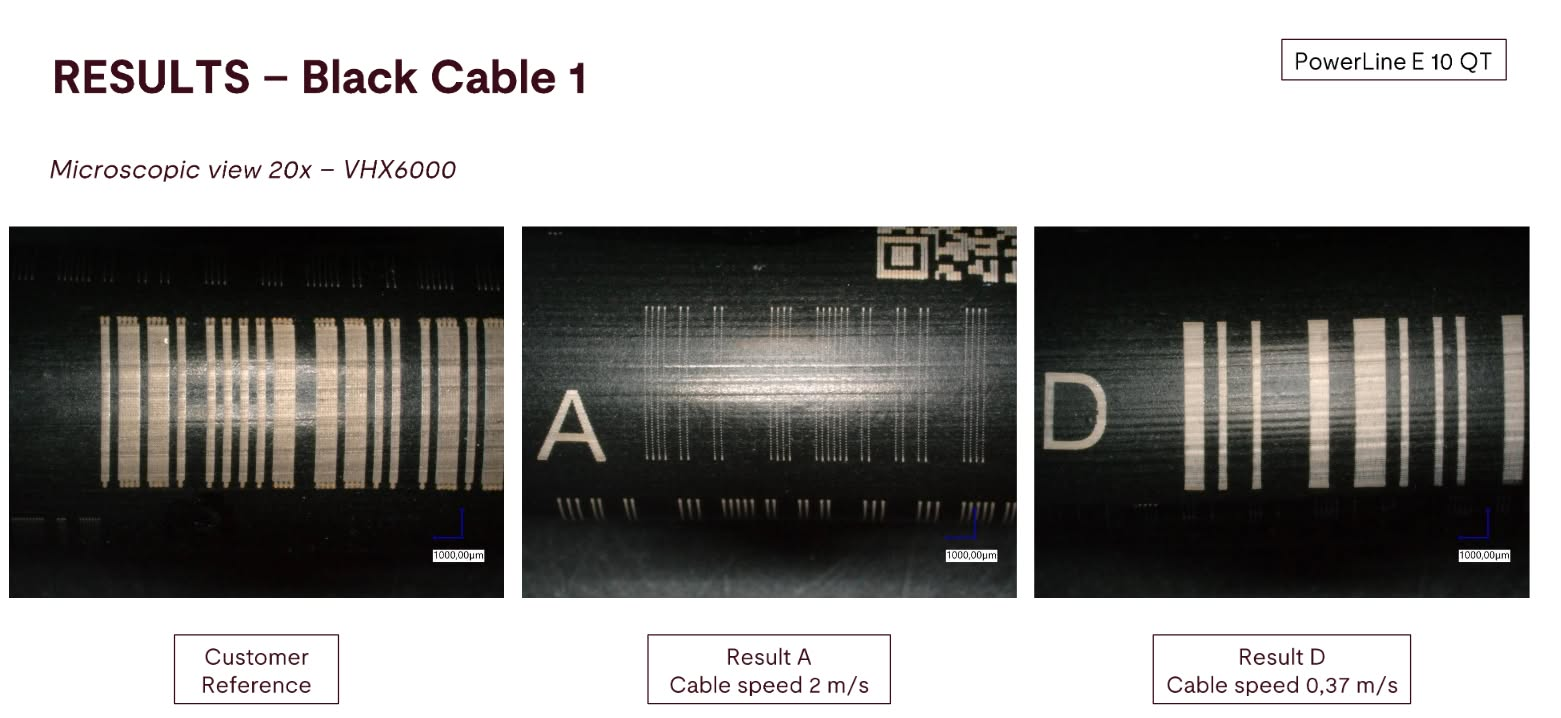
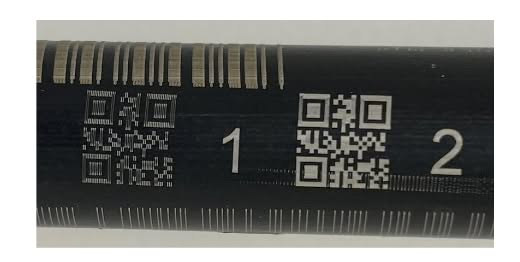
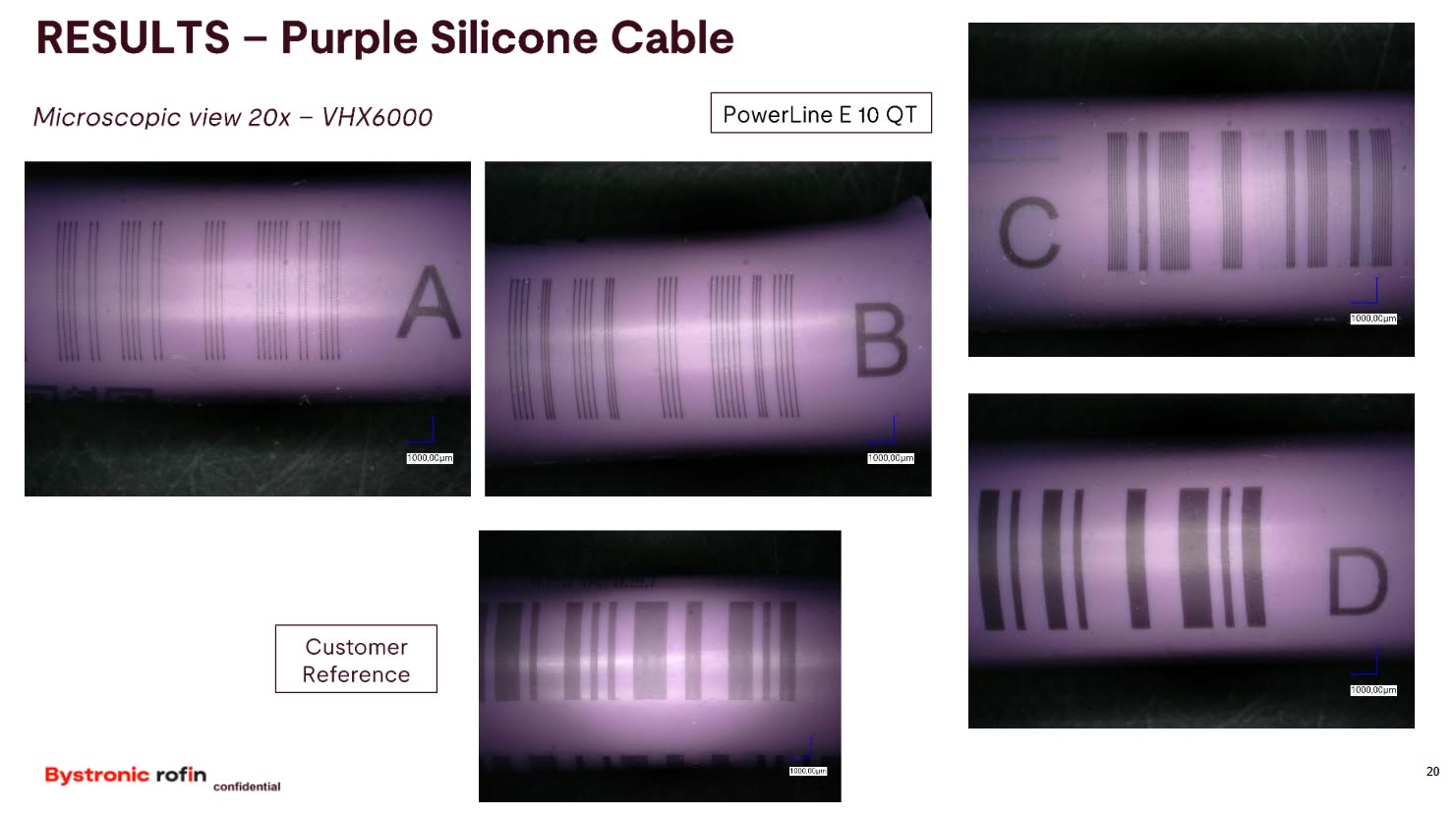
Measured values when marking with the PowerLine E 10 QT system (10 W)
| Material | Code Identifier | Cable Speed | Marking Time | Result and Readability (verified with Cognex scanner) |
|---|---|---|---|---|
| Black cable 1 (matte) | Code A | 2.00 m/s | 0.12 s | Insufficient contrast, unreadable. |
| Code C | 1.00 m/s | 0.22 s | Successfully read. | |
| 2D QR code no. 2 | 0.75 m/s | 0.30 s | Easily read. | |
| Black cable 2 (glossy) | Code A | 2.00 m/s | 0.12 s | Unreadable, glossy texture limits absorption. |
| Code D | 0.37 m/s | 0.58 s | Easily read. | |
| Purple silicone | Code A | 2.00 m/s | 0.12 s | Successfully read, meets the limit |
| 2D QR code no. 1 | 1.80 m/s | 0.12 s | Successfully read. |
3. Implementation of UV Technology 355 nm – PowerLine E 30 QT System (30 W)
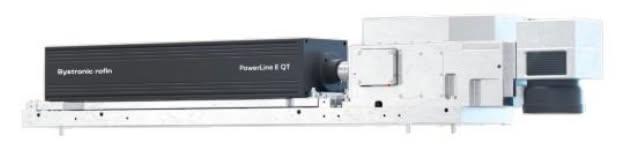
To ensure one hundred percent readability and flawless contrast on all materials at a speed of 2 m/s, it was necessary to deploy a source with a higher power reserve. The PowerLine E 30 QT system based on a nanosecond UV laser (nominal power 30 W @ 60 kHz) significantly increased the energy transfer into the material structure.
The difference in results clearly shows that the additional power completely eliminates beam absorption problems in black and glossy plastics.
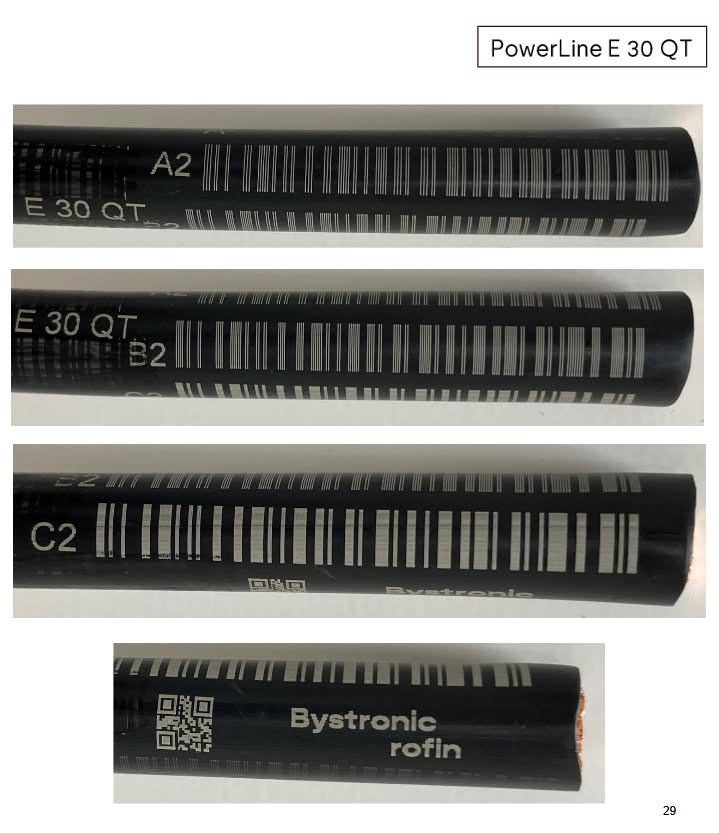
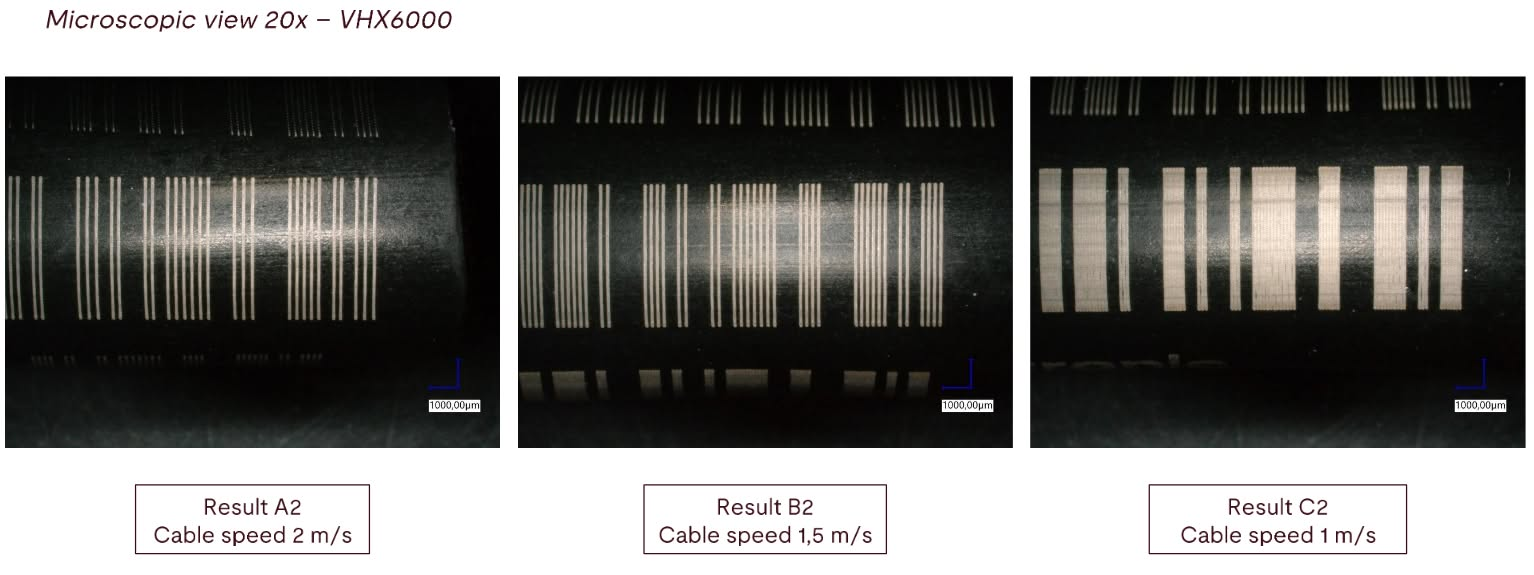
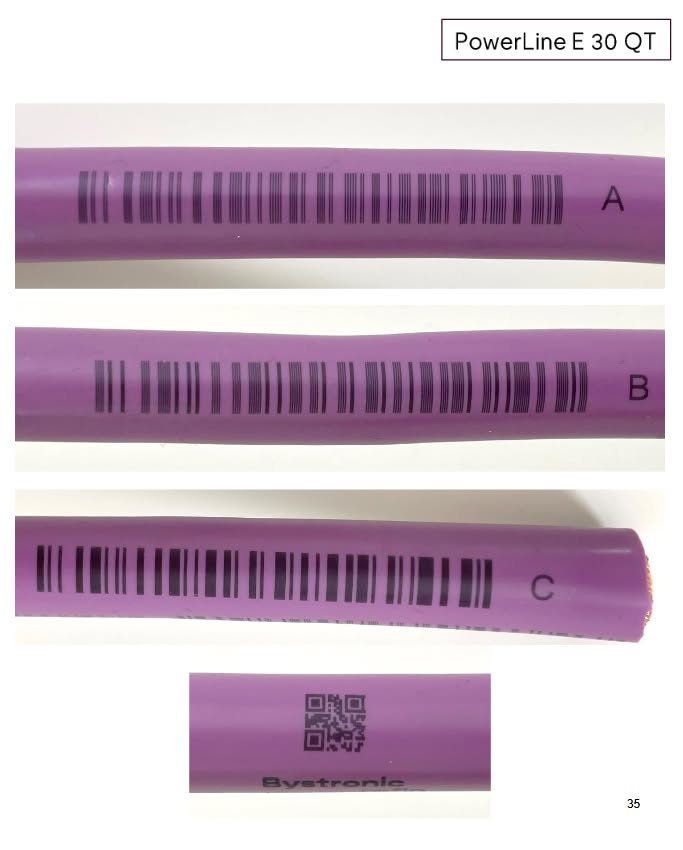
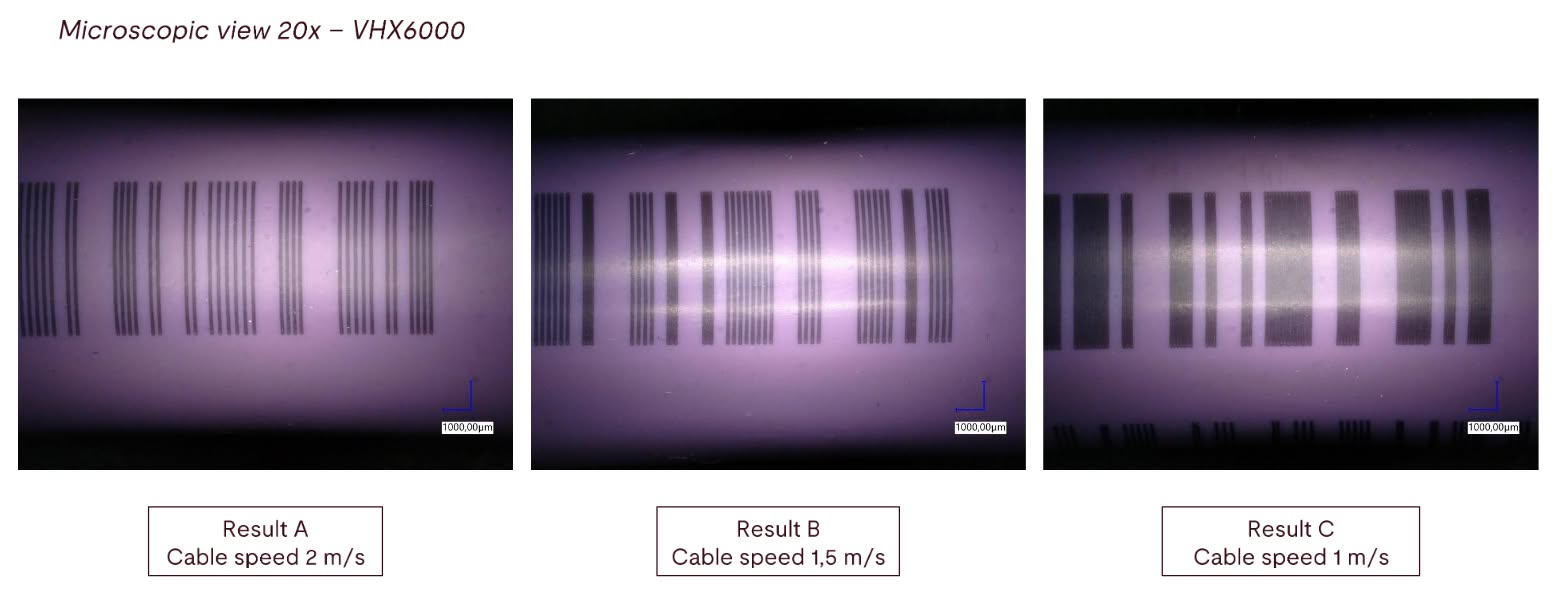
Measured values when marking with the PowerLine E 30 QT system (30 W)
| Material | Code Identifier | Cable Speed | Marking Time | Result and Readability (verified with Cognex scanner) |
|---|---|---|---|---|
| Black cable 1 (matte) | 1D Code A2 | 2.00 m/s | 0.11 s | 100% readable, sharp contrast |
| 2D QR code | 2.00 m/s | 0.10 s | Successfully read | |
| Black cable 2 (glossy) | 1D Code A | 2.00 m/s | 0.11 s | 100% readable, sharp contrast |
| 2D QR code | 2.00 m/s | 0.10 s | Successfully read | |
| Purple silicone | 1D Code A | 2.00 m/s | 0.11 s | 100% readable, improved contrast |
| 2D QR code | 2.00 m/s | 0.10 s | Successfully read |
4. Process Stability and Data Throughput
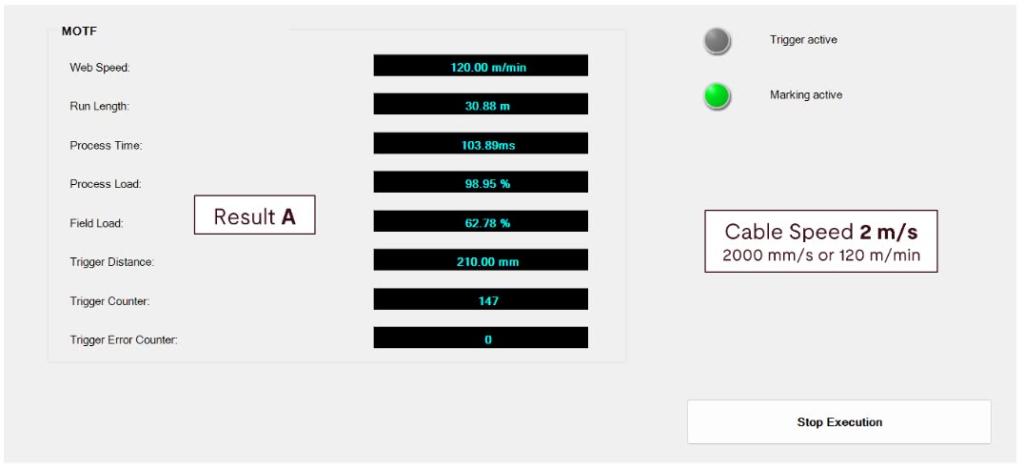
Tests carried out in the Bystronic Rofin console simulator verified complete system stability under repeated load. With the PowerLine E 30 QT system, the code generation process ran smoothly even after more than 100 iterations without triggering errors in the "Trigger Error Counter" at the required web speed of 120 m/min. In addition, the Visual Laser Marker (VLM) control software natively supports ongoing modification of code content (serial numbers, time stamps) even at these high speeds using dedicated real-time variables.
Conclusion and Recommendations
A critical analysis of the measured data demonstrates that, in order to uncompromisingly meet the requirement of marking complex structures (1D and 2D codes) into difficult-to-absorb insulation plastics at a speed of 2 m/s, the UV system Coherent PowerLine E 30 QT is the necessary technical minimum. The 10 W system is energetically insufficient for black polymers at this speed. The 30 W UV system guarantees precise focusing, sufficient power reserve for glossy plastics, and stable MOTF synchronization while maintaining full machine readability.