
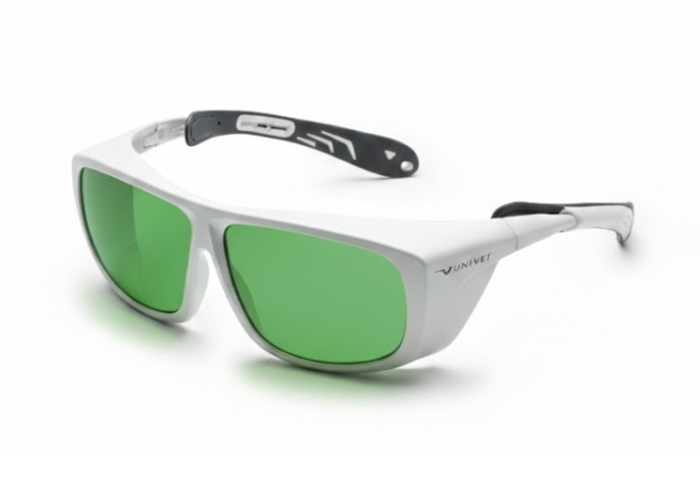
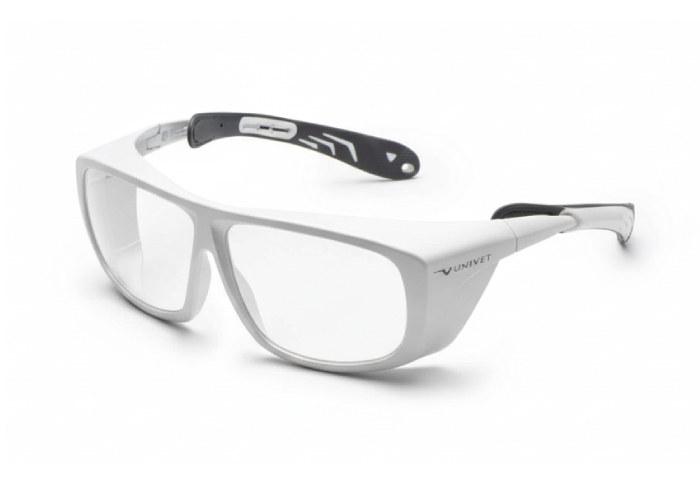
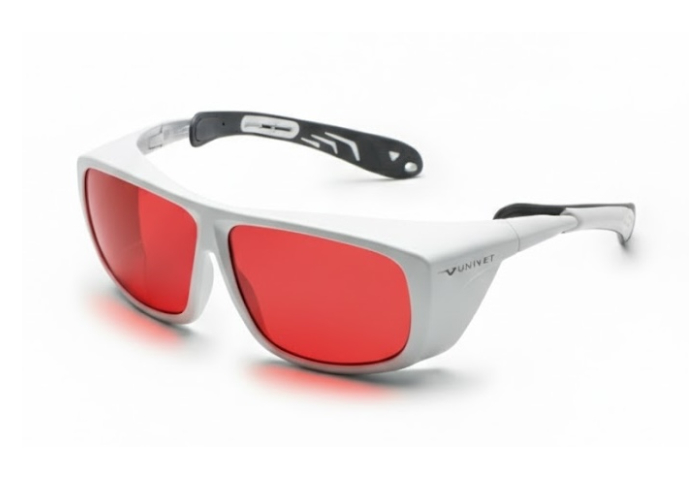
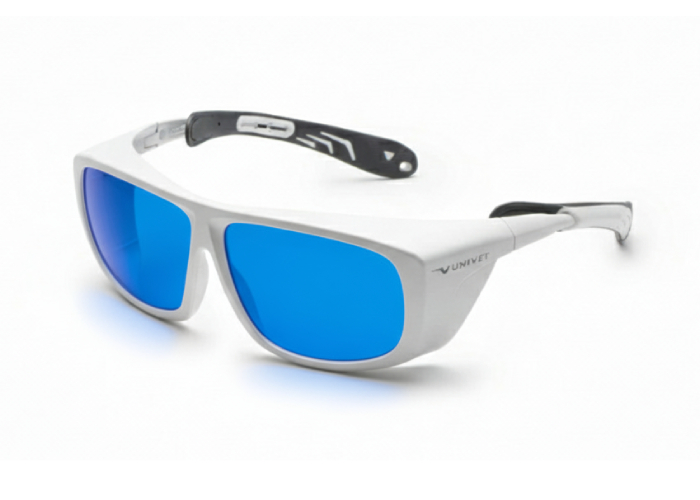
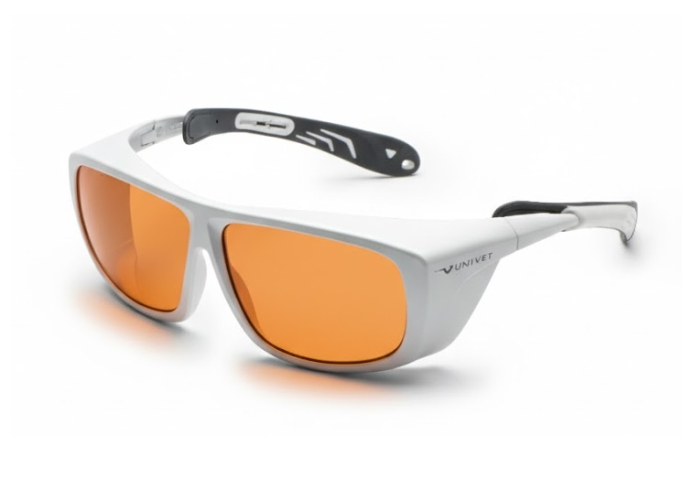
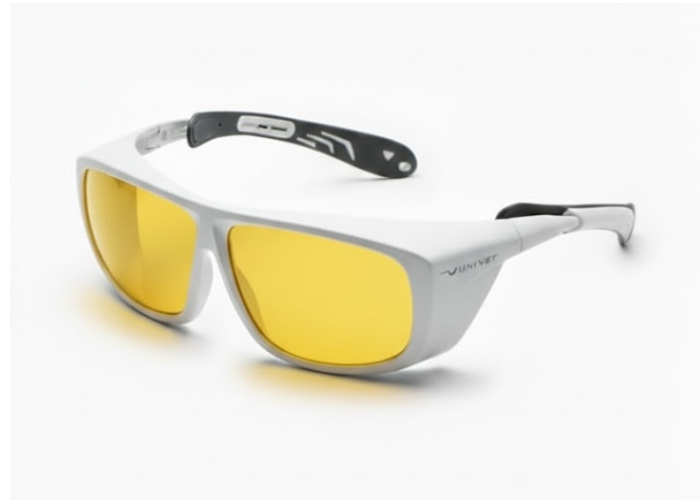
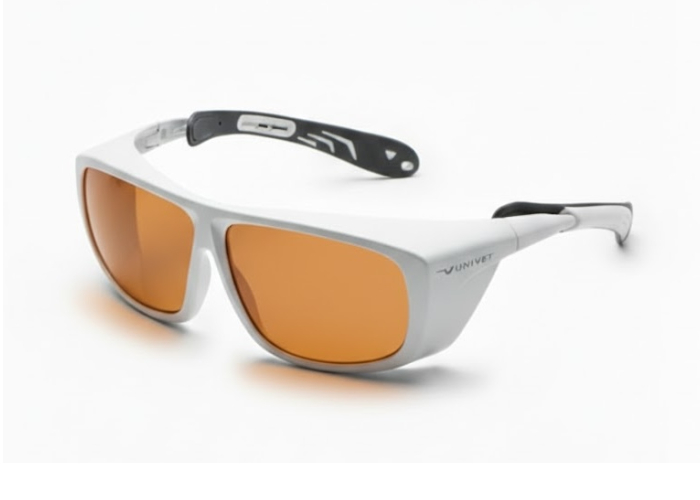
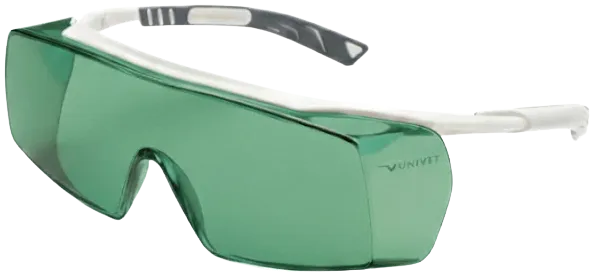
Certification and Ergonomics (EN 207 / EN 208)
All goggles in our online store undergo rigorous testing and carry valid European certification for full protection (EN 207) or adjustment (EN 208).
We offer top-of-the-line frames (including popular models from the UNIVET brand) that combine protection with maximum user comfort. You can choose from lightweight models for all-day wear, sturdy aluminum shields for heavy industry, and spacious OTG (Over-The-Glass) models that fit comfortably over your own prescription glasses.
Occupational Safety and Health and Legal Liability When Working with Lasers
The use of laser systems in the workplace is not only a matter of operational safety but also involves clearly defined legal responsibilities for the employer. Improperly selected or uncertified safety goggles can pose not only a health risk to the operator but also a serious problem during OSH inspections, internal audits, or when handling workplace accidents.
According to the Labor Code (Act No. 262/2006 Coll.) and Government Regulation No. 390/2021 Coll., the employer is obligated to provide employees, free of charge, with personal protective equipment (PPE) appropriate to the specific risks, if the risks cannot be eliminated or sufficiently mitigated by other means (such as protective laser windows and curtains).
In the case of lasers (optical radiation), the limits and conditions are defined by Government Regulation No. 291/2015 Coll. In practice, this means the proper design of protective lenses, screens, and other technical elements, as well as the precise selection of certified safety glasses based on wavelength, laser power, operating mode, and exposure conditions.
The most common mistakes when selecting:
- False universality: Use of uncertified goggles without documented protection for a specific wavelength.
- Underestimation of parameters: Selection based solely on wavelength without considering power and operating mode (continuous CW vs. pulsed mode).
- Missing documentation: Lack of certification according to EN 207 / EN 208 standards, which is crucial for auditors and inspectors.
- Neglected condition: Use of damaged or optically degraded filters that no longer provide the declared protection.
These errors can not only endanger the operator’s eyesight but also call into question the employer’s compliance with obligations during labor inspections.
Confidence in the right choice and expert recommendations For most common applications (e.g., standard workshop engravers or basic marking systems), our predefined categories—which take into account typical power levels and wavelengths—will reliably guide you to a safe solution.
However, if you work with high-power industrial machines, specific lasers, or are simply unsure, we recommend not leaving the selection to guesswork. In such cases, the filter protection level (LB) is a technical parameter calculated according to EN 207 / EN 208 based on power density, energy, and pulse duration. We’d be happy to help you with this. Based on your machine’s parameters, we’ll verify the correct protection level and recommend a solution that will stand up not only during normal operation but also during an occupational safety and health audit. With every pair of goggles delivered, you’ll receive a safety certificate for your records.
These errors can not only endanger the operator’s eyesight, but also call into question the employer’s compliance with their obligations during labor inspections.
Confidence in the right choice and expert recommendations For most common applications (e.g., standard workshop engravers or basic marking systems), our predefined categories—which take into account typical power levels and wavelengths—will reliably guide you to a safe solution.
However, if you work with high-power industrial machines, specific lasers, or are simply unsure, we recommend not leaving the selection to guesswork. In such cases, the filter protection level (LB) is a technical parameter calculated according to EN 207 / EN 208 based on power density, energy, and pulse duration. We’d be happy to help you with this. Based on your machine’s parameters, we’ll verify the correct protection level and recommend a solution that will stand up not only during normal operation but also during an occupational safety and health audit. With every pair of goggles delivered, you’ll receive a safety certificate for your records.
Basic Rules for Choosing
- No pair of goggles is one-size-fits-all: Never choose goggles based on the lens color. The decisive factor is always the type of laser and its specific wavelength (e.g., 1064 nm for fiber lasers vs. 10,600 nm for CO₂ lasers). For easy navigation, we have divided our portfolio into the relevant categories below.
- Consider the laser power and mode: Knowing just the wavelength is not enough. The laser’s power and operating mode are also important. While you can easily select standard lasers directly from our categories, high-power industrial machines—and especially pulsed lasers—require highly durable filters. These must withstand enormous peak powers in the nanosecond range, and for such applications, precise calculations are essential.
- Beware of uncertified copies: You only have one pair of eyes. Don’t rely on cheap, uncertified products. These glasses often fail to meet the stated protection levels, or these parameters (the ability to block UV rays) are not consistent across the entire surface of the lens (protective glass). In extreme cases, they can melt instantly upon direct beam impact—as we have personally verified and documented in our protective eyewear test.
- Darker does not mean safer: The safety level of laser safety goggles is determined exclusively by the filter protection class (LB). Whether the glasses are darker or lighter (VLT parameter) affects your visual comfort, the degree of glare from the laser’s bright focal point, and your ability to see details in the workplace.
Related articles
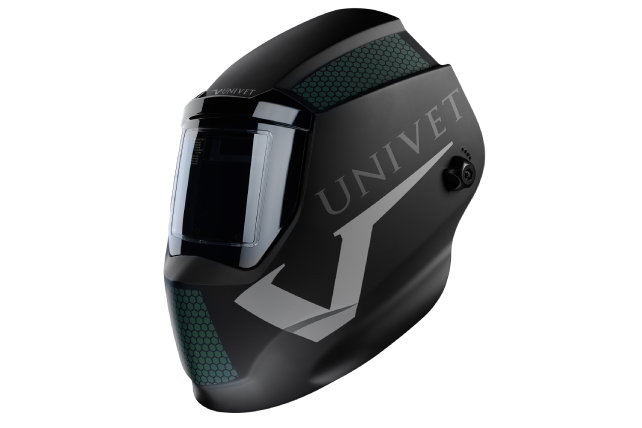
New: Univet MASTR Laser Welding Helmet with Even Greater Protection
We would like to inform you about an important technical improvement to the popular UNIVET MASTR las...
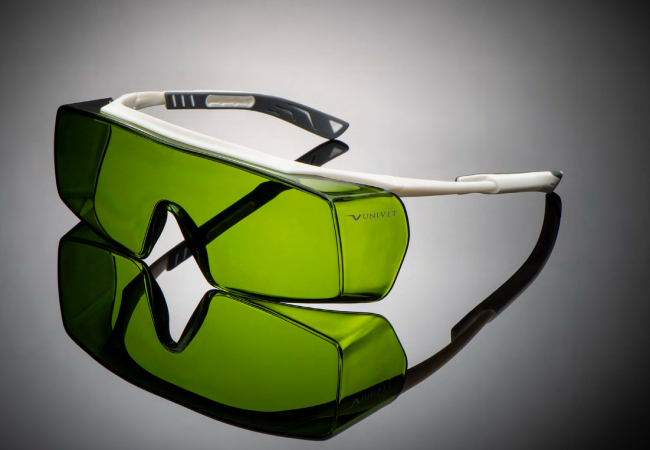
Certified glasses: Reliable eye protection
Working with lasers requires 100% eye protection. Laser radiation is invisible and can cause permane...
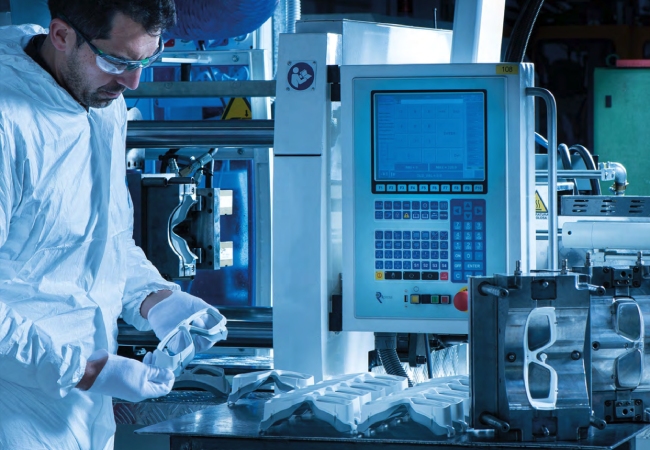
Cheap laser protection glasses?
More and more attractively priced laser safety glasses are appearing on the market, especially from ...